
Planned dashboard
See the signals
- Live values from eight stretch-sensing zones
- Acceleration and rotation readings
- Side-by-side left/right comparisons
- A warning when incoming data becomes stale
Ranjit Global is developing fitness concepts that move beyond passive tracking and toward useful, movement-aware feedback.
FormFiber is a one-piece smart fitness suit being developed to make body movement easier to understand. Eight experimental fabric stretch-sensing zones, arranged in four left/right pairs, work alongside a six-axis motion sensor. A removable pod at the wearer’s left waist is designed to connect wirelessly to a live browser dashboard.
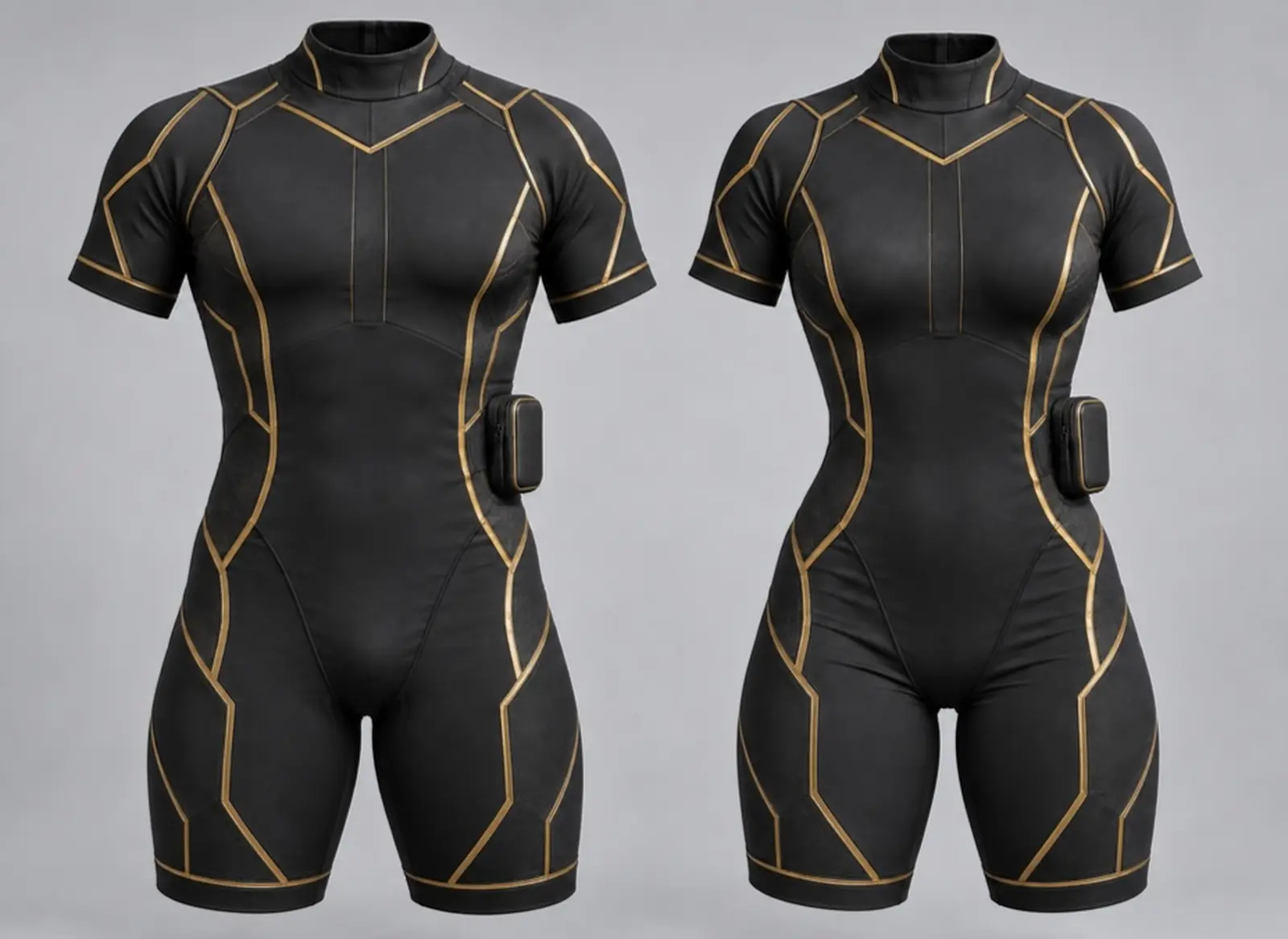 Male fit
Female fit
Male fit
Female fit
Instead of relying only on wrist movement, the concept explores how fabric stretches across the body. The first prototype will focus on making those signals visible and comparing left and right responses during simple movements.
The first engineering sample is planned for supervised dry-use movement tests. Its readings will help evaluate the sensing system before more advanced fitness feedback is developed.
The back zipper provides access to the stretch suit, with a removable pod at the wearer’s left waist.
Eight experimental fabric-sensing zones and a six-axis motion sensor are planned to record movement signals.
The pod is designed to send readings wirelessly to a dashboard in desktop Chrome.
View sensor values, compare left/right responses, and export a CSV file for further analysis.
A good wearable must earn its place on the body. That requires physical samples, diverse fit testing, wash validation, and honest accuracy limits.
Validate sensor behavior, electronics, fit, Bluetooth, and the first motion algorithms.
Test washability, sweat, impact, RF behavior, sizing, and repeatable calibration.
Establish controlled assembly, test fixtures, traceability, and acceptable pilot yield.
Move only after quality limits, compliance, supplier controls, and a golden sample are approved.
Fitness technology should make movement easier to understand, not bury the athlete in noise.Ranjit Global product principle
TITANRESERVE is a wearable hip-assist exoskeleton in development for repetitive lifting, carrying, and material handling. Its planned system stores mechanical energy between lifts, then contributes controlled hip-extension assistance as the wearer stands. The wearer stays in control of the movement.
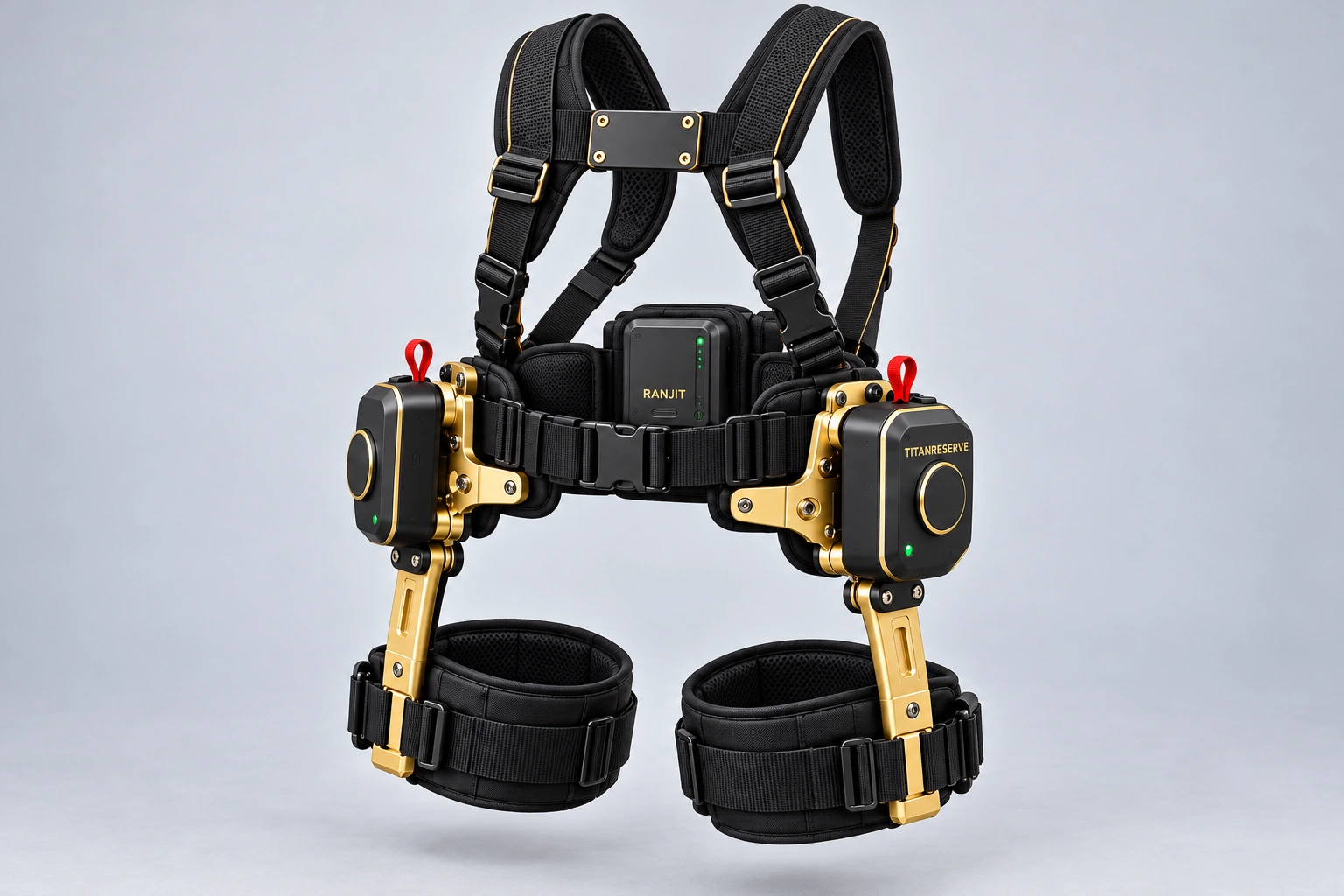
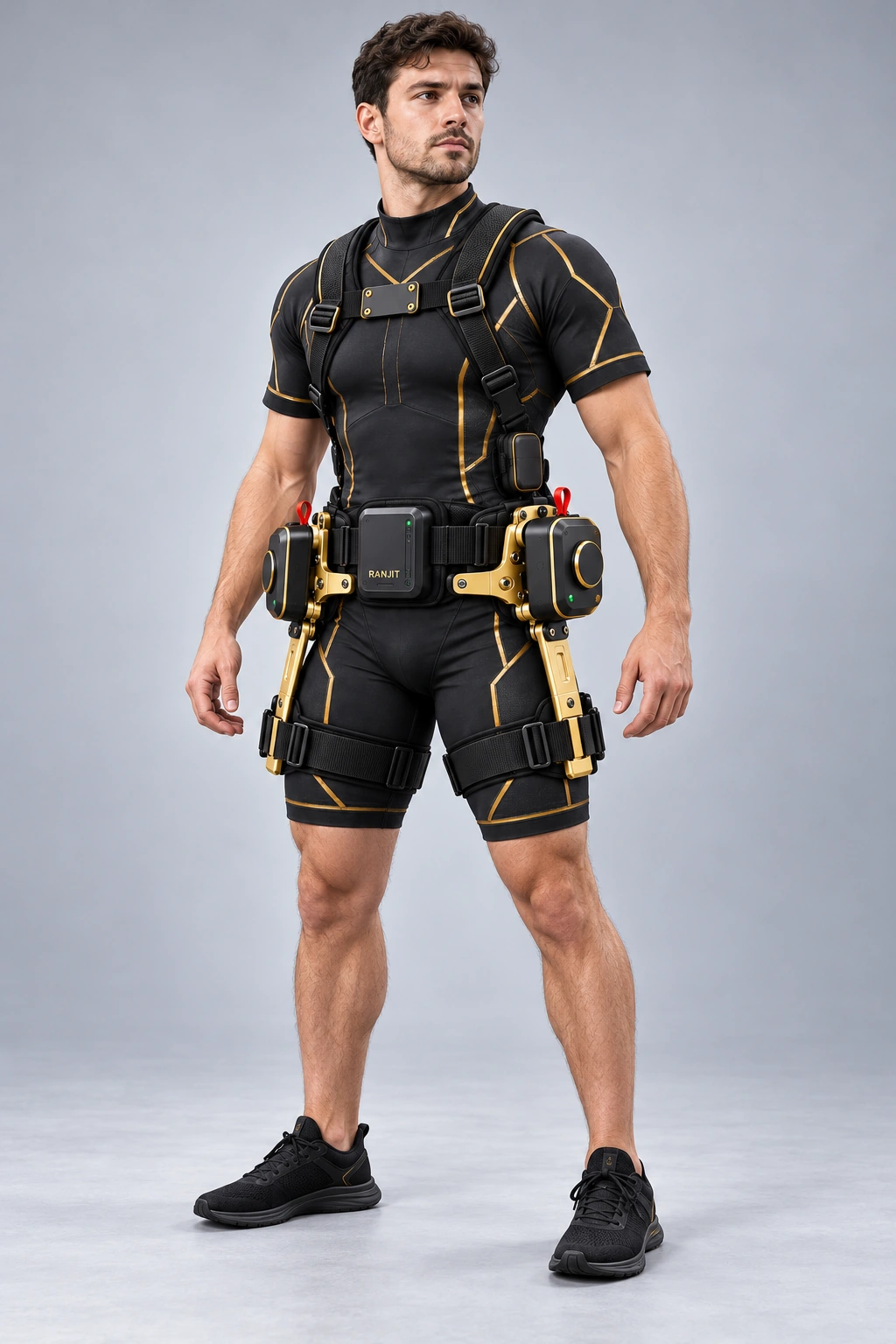
The proposed structure keeps heavy components close to the pelvis and ends at the upper thighs. A torso harness and pelvic frame are intended to distribute reaction loads while thigh linkages deliver assistance.
A compact motor is planned to preload a contained spring while the wearer-side output is isolated. A controlled clutch would then couple the stored energy to the thigh linkage during approved standing motion.
The first milestone is one guarded, instrumented hip module. Measured assistance, release behavior, and spring containment must be validated before passive fit studies and controlled wearable evaluation.
The concept proposes physical OFF/FREE, LOW, MEDIUM, and HIGH settings. Assist levels, free movement, and an independent mechanical release remain engineering and testing requirements.
A battery powers a compact motor that preloads the spring. The output remains isolated from the wearer during charging.
Concept walkthrough. This animation illustrates the planned sequence, not measured product performance.